


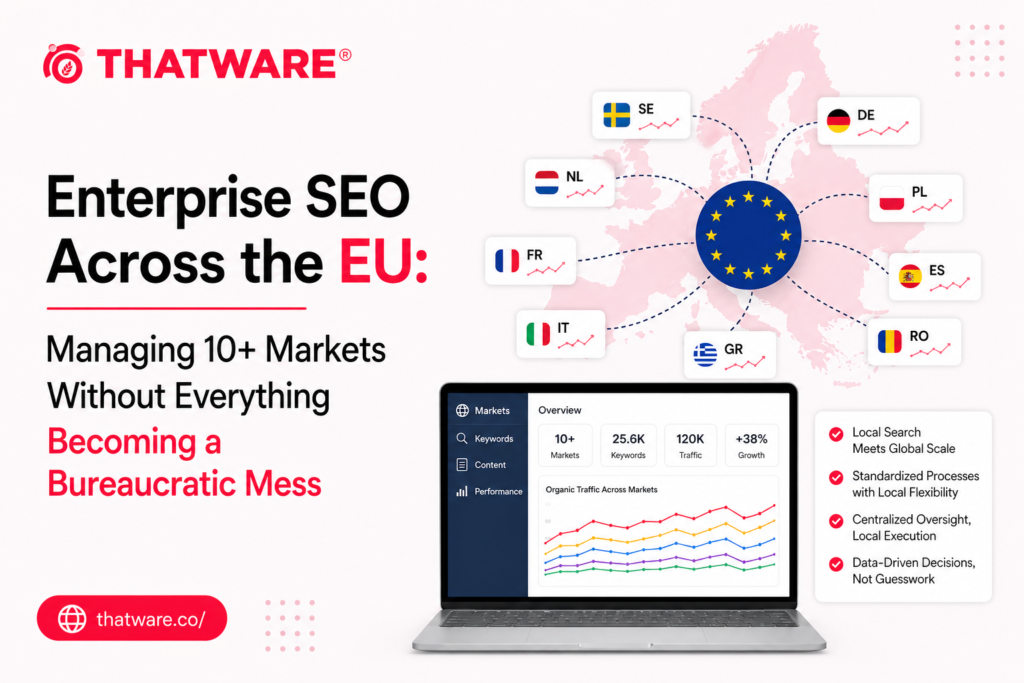
Anyone who’s run a multinational SEO program across European markets knows the specific exhaustion of it. You’re not just dealing with language variations. You’re dealing with different search behaviors, different competitive landscapes, different regulatory environments, different content approval processes, different local stakeholders with different opinions about what the website should say. And somewhere in the middle of all that, you still need to produce measurable organic results. The firms that genuinely understand enterprise seo europe aren’t the ones promising to make it simple. They’re the ones who’ve actually built systems for managing the complexity without letting the complexity become the entire job. Partnering with the right european seo company means finding a team that has worked through these structural problems before, not one that’s going to learn on your budget.
Here’s what running a serious European SEO program actually involves.
The hreflang Problem Nobody Warns You About
If you’re operating across multiple EU markets with localized content, hreflang is non-negotiable. It tells search engines which version of your content is intended for which language and region, preventing your French content from cannibalizing your Belgian French rankings, your Spanish content from confusing signals across Spain and Latin American markets you might also be targeting.
The implementation sounds straightforward. In practice, it’s one of the most commonly broken elements on large multinational sites. Incorrect hreflang annotations, missing return links, conflicting signals between sitemap declarations and on-page implementation — these problems are endemic on enterprise European sites, and they create real ranking damage that’s often hard to diagnose.
A competent enterprise SEO team will audit hreflang as a first priority. If the agency you’re evaluating doesn’t mention it early in the conversation, that’s worth noting.
Content Strategy Across 10+ Markets
Here’s the tension at the heart of European content SEO: full localization is expensive and slow, but thin translation is ineffective and sometimes actively harmful.
The middle path most successful programs find involves tiering your markets. Tier one markets (typically your highest revenue or highest strategic priority) get fully localized content — original research adapted for local audiences, locally-relevant examples, content written by people who understand the cultural context. Tier two markets get intelligent adaptation: not direct translation, but thoughtful reworking that preserves the quality of the original while making it relevant locally. Tier three markets might operate with lighter localization, supplemented by strong technical SEO and strategic link acquisition.
This tiering approach only works if it’s planned deliberately from the start. Retrofitting it onto an existing program is painful. Getting it right upfront is one of the most valuable things a strong European SEO partner can help you do.
GDPR and Its Ongoing SEO Implications
Most marketers know GDPR at the level of cookie consent banners. Fewer have thought through its ongoing implications for SEO data collection, user behavior analytics, and the way you approach content personalization.
Under GDPR, the data you can use to understand your organic audience is more limited than in other markets. Attribution modeling is more complex. The signals you might use in the US or UK to understand which content is performing and why are partially obscured by consent requirements. A sophisticated European SEO program needs to account for this in how it structures measurement and makes decisions.
The agencies that do this well have built workflows that don’t depend on perfect data, that triangulate from multiple signals, and that can demonstrate SEO impact through metrics that survive consent requirements. That’s a more sophisticated measurement capability than most generalist agencies have developed.
Managing Local Stakeholders Without Losing Momentum
This is the part that doesn’t make it into SEO guides but dominates the actual work of European SEO programs: navigating internal politics across markets.
Every market has local stakeholders who believe they understand their audience better than anyone else (often correctly) and who have opinions about website content that may or may not align with SEO best practices (less reliably). Getting content approved, getting technical changes implemented, getting buy-in for a redirect that needs to happen — these things take longer in multi-market enterprises, and they take longer still when the people making decisions are in different time zones speaking different languages.
The best European SEO programs build governance frameworks upfront. Clear decision rights, defined escalation paths, agreed timelines for content review and technical implementation. It’s the un-glamorous work that makes everything else possible.
What Good European SEO Measurement Looks Like
Reporting across 10+ markets creates its own complexity. Rolling everything into a single traffic and rankings dashboard obscures what’s actually happening at the market level. Reporting everything separately creates information overload.
The answer is layered reporting: an executive summary that shows aggregate performance and the health of priority markets, plus market-level detail for stakeholders who need it. Both layers should connect to revenue, not just traffic. Traffic numbers that aren’t anchored to business outcomes are noise in enterprise SEO, and senior stakeholders who see through that noise will start losing confidence in the program.
European SEO done properly is complex, resource-intensive, and slow to show full results. It’s also one of the highest-leverage marketing investments an enterprise business can make in markets where organic search remains a dominant discovery channel. The complexity is manageable. It just needs to be managed deliberately.